:max_bytes(150000):strip_icc():format(webp)/1WTC-600966484-58697c383df78ce2c3e692d1.jpg)
:max_bytes(150000):strip_icc():format(webp)/left_rail_image_visual_arts-58a22da368a0972917bfb5d5.png)
:max_bytes(150000):strip_icc():format(webp)/Jackie-Craven-ThoughtCo-58eeac613df78cd3fc7a495c.jpg)
Some photos still show scaffolding, construction cranes, and security fences at ground zero in New York City, but it's not like it used to be. Lots of people have returned to the site, gone through airport-like security, and are realizing that construction is both above- and below-ground level, from the 100th floor of One World Observatory to the underground slurry wall in Foundation Hall of the 9/11 Memorial Museum. New York is recovering from the ruins left after the September 11, 2001 terrorist attacks. One by one, the buildings rise.
1 World Trade Center
:max_bytes(150000):strip_icc():format(webp)/WTC-509936075-56aad5853df78cf772b49090.jpg)
As New York removed debris from ground zero, architect Daniel Libeskind proposed a sweeping master plan in 2002 with a record-breaking skyscraper that became known as Freedom Tower. A symbolic cornerstone was placed on July 4, 2004, but the building's design evolved and construction did not begin for another two years. In 2005 architect David Childs and Skidmore Owings & Merrill (SOM) took the lead, while Libeskind focused on the overall master plan for the site. Childs was the design architect for buildings Seven and One, while his SOM colleague Nicole Dosso was the project manager architect for both.
Now called One World Trade Center, or 1WTC, the central skyscraper is 104 stories, with an enormous 408-foot steel spire antenna. On May 10, 2013, the final spire sections were in place and 1WTC reached its full and symbolic height of 1,776 feet, the tallest building in the United States. By September 11, 2014, the omnipresent exterior elevator hoist was dismantled for the building's official opening in November 2014. Over several months in 2014 into 2015, thousands of office workers moved into over 3 million square feet of office space. The observation area on floors 100, 101, and 102 opened to the public in May 2015.
2 World Trade Center
:max_bytes(150000):strip_icc():format(webp)/architecture-2wtcBIG-memside-crop-5b75e581c9e77c00252d9ccd.jpg)
BIG/Silverstein Properties, Inc.
Everyone thought that Norman Foster's plans and designs from 2006 were set, but the second tallest World Trade Center tower had new tenants sign up, and with them came a new architect and new design. In June 2015 the Bjarke Ingels Group (BIG) presented a two-faced design for 2WTC. The 9/11 Memorial side is reserved and corporate, while the street side facing Tribeca is stepped and residentially garden-like.
But in 2016 the new tenants, 21st Century Fox and News Corp. pulled out, and the developer, Larry Silverstein, may have his architects rethink the design to match non-media tenants. Although foundation construction began in September 2008, the status of the tower construction, with its foundation at grade-level, has remained at the "Concept Design" stage for years. The vision and revision of 2WTC plans are available for the next tenant who will sign on the dotted line.
3 World Trade Center
:max_bytes(150000):strip_icc():format(webp)/architecture-3WTC-971689384-5b75de9f46e0fb005079fe49.jpg)
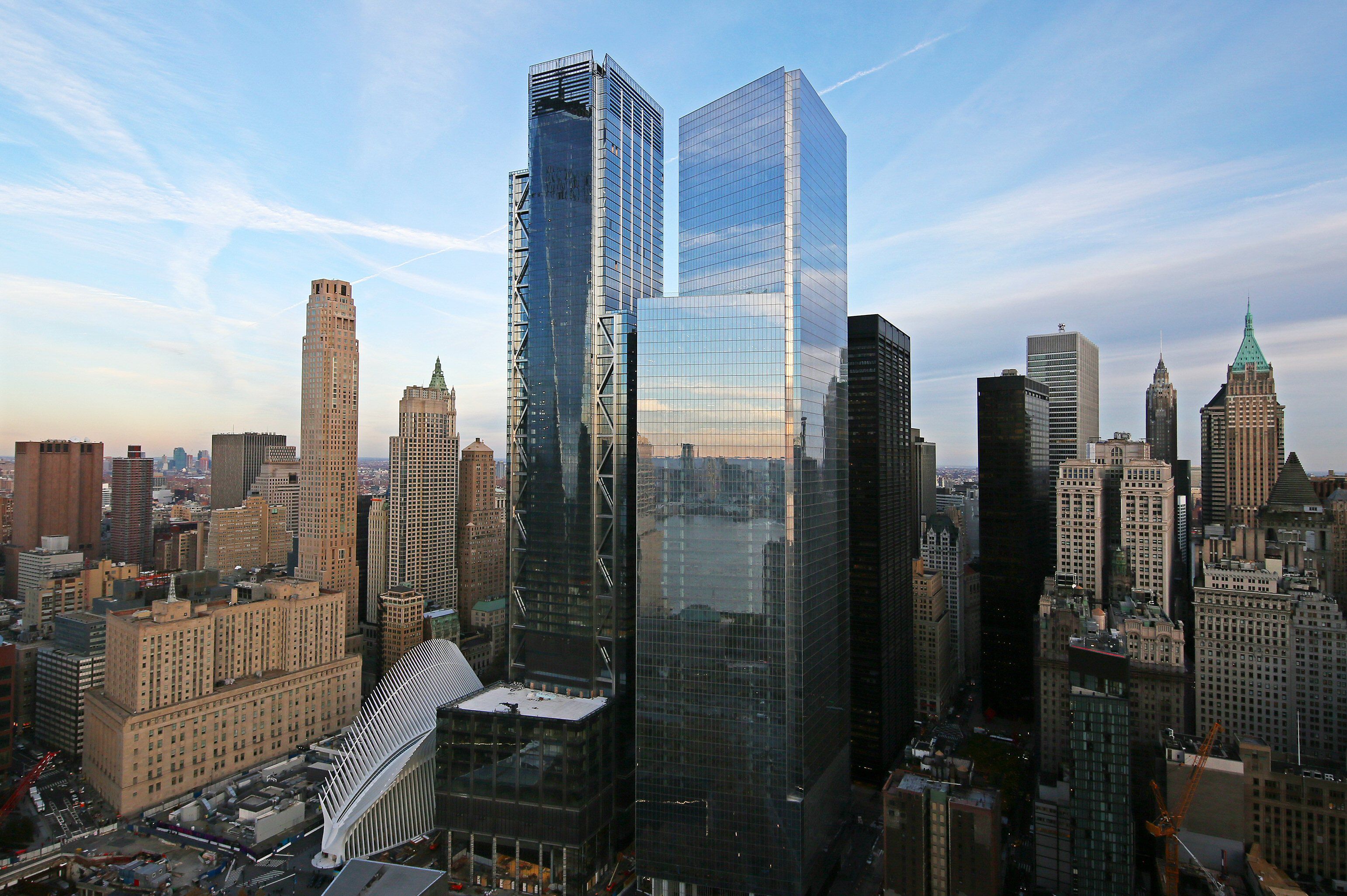
High-tech Pritzker Prize-winning architect Richard Rogers and Rogers Stirk Harbour + Partners designed a skyscraper using a complex system of diamond-shaped braces. Like neighboring skyscrapers, Three World Trade Center has no interior columns, so the upper floors offer unimpeded views of the World Trade Center site. Rising to 80 stories in 1,079 feet, 3WTC is the third tallest in height, after the celebrated 1WTC and the proposed 2WTC.
Foundation work at 175 Greenwich Street began July 2010, but in September 2012 construction of the lower "podium" stalled after reaching a seven-story height. In 2015, new tenants were signed up, and 600 workers a day were on-site to assemble 3WTC at a frantic pace, zooming past the height of the Transportation Hub next door. Concrete construction topped out in June 2016 with the steel topping out not far behind. The grand opening was in June 2018, looking very much like like the design architect Rogers presented in 2006.
4 World Trade Center
:max_bytes(150000):strip_icc():format(webp)/architecture-4WTC-JC2013-044948-crop-5b75fd1446e0fb002583a584.jpg)
WTC tower four is an elegant, minimalist design by Fumihiko Maki's Maki and Associates, an architecture team with a portfolio of dignified structures throughout the globe. Each corner of the skyscraper rises to a different height, with the highest elevation at 977 feet. The Japanese architect designed Four World Trade Center to complete the spiral configuration of towers on the World Trade Center site.
Construction began in February 2008 and was one of the first completed, opening November 13, 2013. For nearly five years it stood alone, with spectacular office views. Since the rise of 2WTC next door, however, the World Trade Center row of rebuilding along Greenwich Street is beginning to make the area look a bit cramped. Four World Trade Center now has some competition from Three World Trade Center looming right next door.
World Trade Center Transportation Hub
:max_bytes(150000):strip_icc():format(webp)/WTC-transportation-hub-600966500-58cf5de05f9b581d7201979c.jpg)
Spanish architect Santiago Calatrava designed a bright, uplifting transportation terminal for the new World Trade Center. Located between towers two and three, the hub provides easy access to the World Financial Center (WFC), ferries, and 13 existing subway lines. Construction on the expensive building began September 2005, and it opened to the public in March 2016. Photos do not do justice to the spiny framed marble structure and the streaming light through the oculus.
The National 9/11 Memorial Plaza
:max_bytes(150000):strip_icc():format(webp)/WTC-memorial-600951714-58cf62b55f9b581d7203d5f0.jpg)
The long-awaited National 9/11 Memorial lies at the heart and soul of the World Trade Center site. Two 30-foot waterfall memorials designed by architect Michael Arad are in the exact locations where the fallen twin towers once soared skyward. Arad's "Reflecting Absence" was the first design to break the plane between above- and below-ground, as the water descends toward the broken foundations of the fallen skyscrapers and to the 9/11 Memorial Museum below. Construction began in March 2006. Landscape architect Peter Walker helped actualize Arad's vision, a serene and solemn area that officially opened on September 11, 2011.
Near the memorial waterfalls sits a large, steel and glass entryway to the National September 11 Memorial Museum. This Pavilion is the only aboveground structure on the 9/11 Memorial Plaza.
The Norwegian architecture firm Snøhetta spent nearly a decade designing and redesigning the Pavilion. Some say its design is like a leaf, complementing Santiago Calatrava's bird-like Transportation Hub nearby. Others see it as a glass shard permanently embedded—like a bad memory—into the landscape of the Memorial Plaza. Functionally, the Pavilion is the entrance to the museum underground.
The National 9/11 Memorial Museum
:max_bytes(150000):strip_icc():format(webp)/WTC-museum-490781315-56aad6723df78cf772b49161.jpg)
Construction of the underground National 9/11 Memorial Museum began in March 2006. The entrance features a glass atrium—an aboveground pavilion—where museum guests are immediately confronted by two steel trident (three-pronged) columns salvaged from the destroyed twin towers. The pavilion transitions the visitor from street-level remembrance down into a place of memory, the museum below. "Our desire," says Snøhetta co-founder Craig Dykers, "is to allow visitors to find a place that is a naturally occurring threshold between the everyday life of the city and the uniquely spiritual quality of the Memorial."
The transparency of the glass design promotes an invitation for visitors to enter the museum and learn more. The pavilion leads down to the subterranean exhibition galleries designed by Max Bond of Davis Brody Bond.
Future generations may ask what happened here, and the 9/11 Museum details the attacks on the World Trade Center. This is where it happened—this is where the towers fell. Artifacts of that day are on display, including the Survivors' Staircase and steel beams from the destroyed twin towers. The 9/11 Museum opened May 21, 2014. It is protected by the National Historic Preservation Act.
From 7WTC to Liberty Park
:max_bytes(150000):strip_icc():format(webp)/architecture-libertypark-543621486-5b760ce7c9e77c00500b10a6.jpg)
The master plan for redevelopment called for a reopening of Greenwich Street, a north-south city street that had been closed off since the mid-1960s and development of the original twin towers area. To the north at 250 Greenwich Street, rebuilding began almost immediately after 9/11. Construction on Seven World Trade Center designed by David Childs and Skidmore Owings & Merrill (SOM) began in 2002. At 52 floors and 750 feet, the new 7WTC was completed first as it sits atop a mass of underground infrastructure. The healing at the north end of Greenwich Street began May 23, 2006, with the grand opening of 7WTC.
On the south end of the World Trade Center site, Liberty Street crosses Greenwich Street. In 2016 an elevated park, Liberty Park, opened. The urban space overlooks the 9/11 Memorial Plaza and is near the rebuilding of the Santiago Calatrava-designed St. Nicholas National Shrine. In 2017 Liberty Park became the permanent home for the iconic "Sphere," a 9/11-damaged sculpture by the German artist Fritz Koenig that stood between the original twin towers.
Performing Arts Center
:max_bytes(150000):strip_icc():format(webp)/Performing_arts_center_at_the_WTC-395a53902b78418ba471bc39d3996b33.jpg)
Jmex/Wikimedia Commons/CC BY-SA 4.0
A Performing Arts Center (PAC) was always part of the master plan. Originally, a 1,000-seat PAC was designed by Pritzker Laureate Frank Gehry. Below-grade work began in 2007, and in 2009 the drawings were presented. The world economic slowdown and Gehry's controversial design put PAC on the back burner.
Then in June 2016, billionaire Ronald O. Perelman donated $75 million for the Ronald O. Perelman Performing Arts Center at the World Trade Center. Perelman's donation is in addition to the millions of dollars of federal money allocated to the project.
It is planned as three small theater spaces arranged so they can be combined to create larger performance areas.
Sources
- National September 11 Memorial Museum Pavilion.
- National September 11 Memorial & Museum. Message from the Museum Director 403.
- National September 11 Memorial & Museum. Memorial Museum FAQ.
:max_bytes(150000):strip_icc():format(webp)/1WTC-458335780-56aad6ab5f9b58b7d0090146.jpg)
:max_bytes(150000):strip_icc():format(webp)/architecture-WTC-skyline-946388544-crop-5af368a3ba61770036afe611.jpg)
:max_bytes(150000):strip_icc():format(webp)/architecture-911destruction-1162748-crop-5b6c64e446e0fb0050cbe33c.jpg)
:max_bytes(150000):strip_icc():format(webp)/1WTC-599300934-58b5fe993df78cdcd8363ce8.jpg)
:max_bytes(150000):strip_icc():format(webp)/skyscraper-NYC-126420770-56aadce93df78cf772b497fb.jpg)
:max_bytes(150000):strip_icc():format(webp)/skyscraper-wainwright-833779848-59acc69e685fbe0010389f62.jpg)
:max_bytes(150000):strip_icc():format(webp)/skyscrapers-Dubai-639373022-crop-59ab4ba96f53ba00115087f0.jpg)
:max_bytes(150000):strip_icc():format(webp)/skyscrapers-dubai-488734758-crop-59ee7c490d327a0010f410b6.jpg)
:max_bytes(150000):strip_icc():format(webp)/skyscrapers-sdearborn-56a02c213df78cafdaa0689b.jpg)
:max_bytes(150000):strip_icc():format(webp)/TurningTorso-94095853crop-57a9ab565f9b58974a1584cb.jpg)
:max_bytes(150000):strip_icc():format(webp)/skyscraper-chicago-479919091-lg-57ac75cd3df78cf4598890c6.jpg)
:max_bytes(150000):strip_icc():format(webp)/Libeskind-95890451-56aad49f5f9b58b7d008ff94.jpg)
:max_bytes(150000):strip_icc():format(webp)/facade-533797085-crop-56aad88b3df78cf772b49350.jpg)
:max_bytes(150000):strip_icc():format(webp)/Bunshaft-Yale-548777307-56aada5b5f9b58b7d00904cb.jpg)
:max_bytes(150000):strip_icc():format(webp)/childengineer-175494195-56a031a35f9b58eba4af4ca5.jpg)
:max_bytes(150000):strip_icc():format(webp)/adaptive-reuse-refineryhotel-roofbararea-JCraven-crop-59c40b9c68e1a20014715c57.jpg)