:max_bytes(150000):strip_icc():format(webp)/stflorian-3258306-crop2-585954b23df78ce2c32555f0.jpg)
:max_bytes(150000):strip_icc():format(webp)/left_rail_image_visual_arts-58a22da368a0972917bfb5d5.png)
:max_bytes(150000):strip_icc():format(webp)/Jackie-Craven-ThoughtCo-58eeac613df78cd3fc7a495c.jpg)
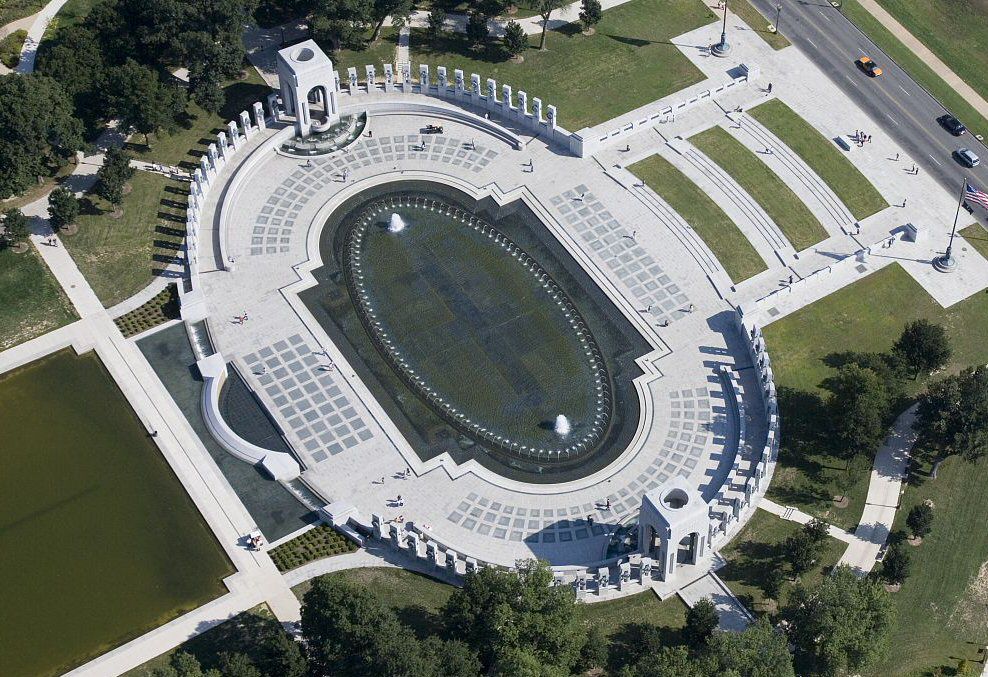
Friedrich St.Florian (born December 21, 1932 in Graz, Austria) is widely known for only one work, the National World War II Memorial. His influence on American architecture is mainly from his teaching, first at Columbia University in 1963, and then a lifetime career at the Rhode Island School of Design (RISD) in Providence, Rhode Island. St.Florian's long teaching career places him at the head of the class for mentoring student architects.
He is often called a Rhode Island architect, although this is an over-simplification of his world vision. Settling in the United States in 1967 and a naturalized citizen since 1973, St.Florian has been called a visionary and theoretical architect for his futuristic drawings. St. Florian's approach to design melds the theoretical (philosophical) with the practical (pragmatic). He believes that one must explore the philosophical background, define the problem, and then resolve the problem with a timeless design. His design philosophy includes this statement:
"We approach architectural design as a process that begins with exploration of philosophical underpinnings leading to concept ideas that will be subjected to vigorous testing. To us, how a problem is defined is critical to its resolution. Architectural design is the process of distillation that purifies the confluence of circumstances and ideals. We deal with pragmatic as well as fundamental concerns. In the end, the proposed design solutions are expected to reach beyond utilitarian considerations and stand as an artistic statement of timeless value."
St.Florian (who leaves no space within his last name) earned a Masters Degree in Architecture (1958) at Technische Universadad in Graz, Austria, before receiving a Fullbright to study in the U.S. In 1962 he earned a Master of Science Degree in Architecture from Columbia University in New York City, and then headed to New England. While at RISD, he received a Fellowship to study at the Massachusetts Institute of Technology (MIT) in Cambridge, Massachusetts from 1970 until 1976, becoming a licensed architect in 1974. St.Florian established Friedrich St.Florian Architects in Providence, Rhode Island in 1978.
Principal Works
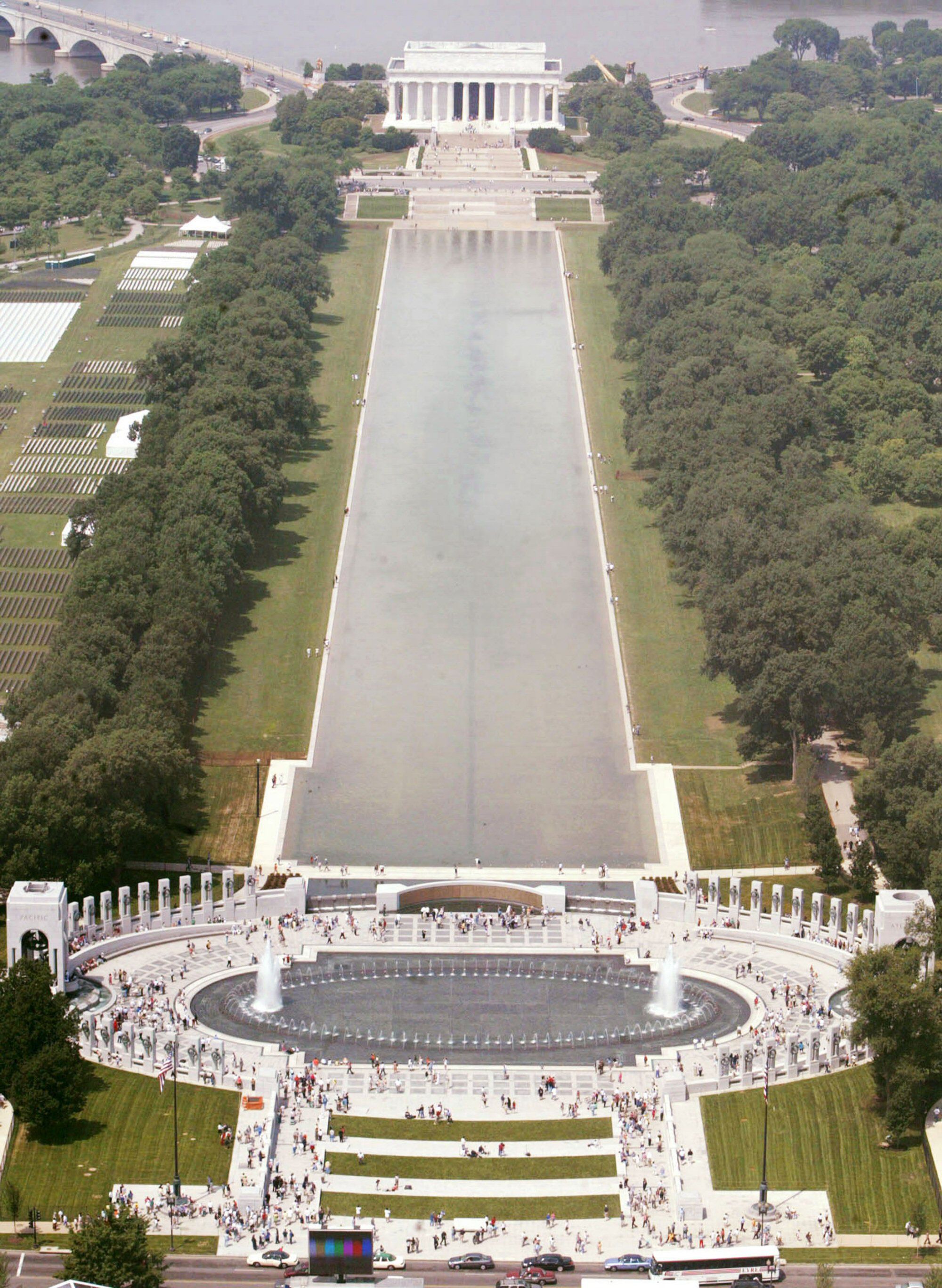
St.Florian's projects, like most architects, fall into at least two categories — works that got built and those that didn't. In Washington, D.C., the 2004 World War II Memorial (1997-2004) stands center stage on the National Mall, in site of the Lincoln Memorial and the Washington Monument. Closer to his own hometown, one finds many projects in and around Providence, Rhode Island, including the Sky Bridge (2000), the Pratt Hill Town Houses (2005), the House on College Hill (2009), and his own home, the St.Florian Residence, completed in 1989.
Many, many architects (most architects) have design plans that are never built. Sometimes they are competition entries that don't win, and sometimes they are theoretical buildings or architecture of the mind — sketches of "what if?" Some of St.Florian's unbuilt designs include the 1972 Georges Pompidour Centre for the Visual Arts, Paris, France (Second Prize with Raimund Abraham); the 1990 Matthson Public Library, Chicago, Illinois (Honorable Mention with Peter Twombly); the 2000 Monument to the Third Millennium; the 2001 National Opera House, Oslo, Norway (compare with the completed Oslo Opera House by the Norwegian architecture firm Snøhetta); the 2008 Vertical Mechanical Parking; and the 2008 House of Arts and Culture (HAC), Beirut, Lebanon.
About Theoretical Architecture
All design is theoretical until actually built. Every invention was previously just a theory of a working thing, including flying machines, super tall buildings, and homes that use no energy. Many if not all theoretical architects believe that their projects are viable solutions to problems and can (and should) be built.
Theoretical architecture is design and building of the mind — on paper, a verbalization, a rendering, a sketch. Some of St.Florian's early theoretical works are part of the Museum of Modern Art's (MoMA's) permanent Exhibitions & Collections in New York City:
1966, Vertical City: a 300-story cylindrical city designed to take advantage of sunlight above the clouds — "The regions beyond the clouds were designated for those most in need of light—hospitals, schools, and the elderly — which could be continually provided by solar technology."
1968, New York Birdcage-Imaginary Architecture: spaces that become real and active only when in use; "As in solid, earthbound architecture, each room is a dimensional space, with a floor, a ceiling, and walls, but it has no physical structure; existing only when "drawn" by the moving airplane, it depends entirely upon the airplane's presence and on the pilot's and air-traffic controller's consciousness of designated coordinates."
1974, Himmelbelt: a four-poster bed (a Himmelbelt), set upon a polished stone foundation and beneath a heavenly projection; described as "the juxtaposition between real physical space and the imaginary realm of dreams"
Fast Facts About the WWII Memorial
"Friedrich St.Florian's winning design balances classical and modernist styles of architecture..." states the National Park Service website, "and celebrates the victory of the greatest generation."
Dedicated: May 29, 2004
Location: Washington, D.C. Constitution Gardens area of the National Mall, in the vicinity of the Vietnam Veterans Memorial and the Korean War Veterans Memorial
Construction Materials:
Granite — approximately 17,000 individual stones from South Carolina, Georgia, Brazil, North Carolina, and California
Bronze sculpting
Stainless steel stars
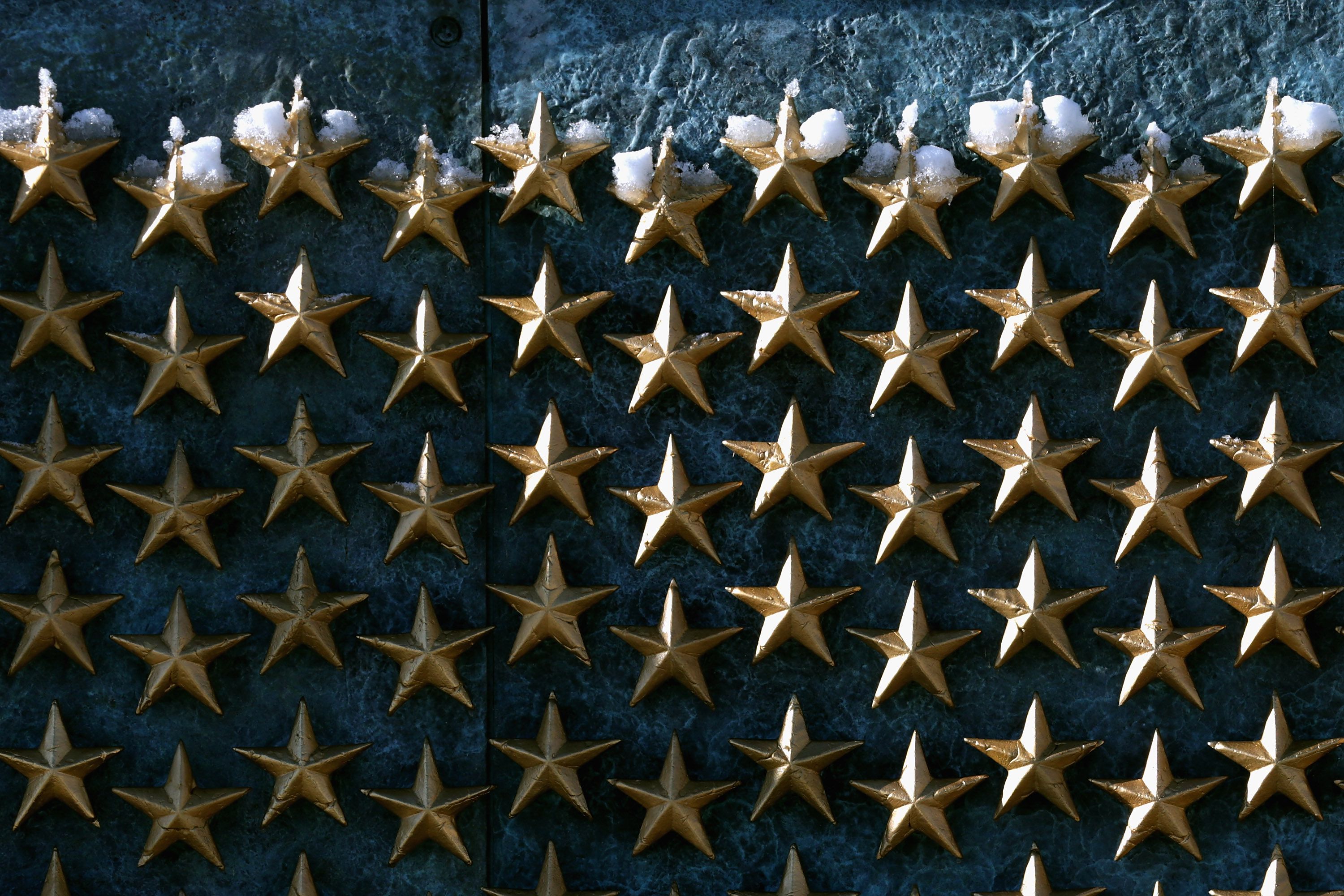
Symbolism of Stars: 4,048 gold stars, each symbolize 100 American military dead and missing, representing more than 400,000 of the 16 million who served
Symbolism of Granite Columns: 56 individual pillars, each represent a state or territory of the U.S. during World War II; each pillar has two wreaths, a wheat wreath representing agriculture and an oak wreath symbolizing industry
Sources
- Elements of the Vertical City by Bevin Cline and Tina di Carlo from The Changing of the Avant-Garde: Visionary Architectural Drawings from the Howard Gilman Collection, Terence Riley, ed., New York: The Museum of Modern Art, 2002, p. 68 (online accessed November 26, 2012).
- Birdcage by Bevin Cline from Envisioning Architecture: Drawings from The Museum of Modern Art, Matilda McQuaid, ed., New York: The Museum of Modern Art, 2002, p. 154 (online accessed November 26, 2012).
- Himmelbelt by Bevin Cline and Tina di Carlo from The Changing of the Avant-Garde: Visionary Architectural Drawings from the Howard Gilman Collection, Terence Riley, ed., New York: The Museum of Modern Art, 2002, p. 127 (online accessed November 26, 2012).
- Frequently Asked Questions, History & Culture, National Park Service Website. NPS website accessed November 18, 2012
- Rhode Island School of Design (RISD) Faculty Profile and Curriculum Vitae (PDF), accessed November 18, 2012; Design philosophy from www.fstflorian.com/philosophy.html, accessed November 26, 2012.
- Getty Images from Mark Wilson and Chip Somodevilla; Library of Congress aerial image by Carol M. Highsmith
:max_bytes(150000):strip_icc():format(webp)/florence-knoll-G85988971-cropwide-56aad6703df78cf772b4915e.jpg)
:max_bytes(150000):strip_icc():format(webp)/philip-johnson-getty825482-56a02d565f9b58eba4af4503.jpg)
:max_bytes(150000):strip_icc():format(webp)/mayalin-452080518-crop-56aad9383df78cf772b49438.jpg)
:max_bytes(150000):strip_icc():format(webp)/mies-3090490-crop-57a9ad2b3df78cf459f322ee.jpg)
:max_bytes(150000):strip_icc():format(webp)/bucky-3223974crop-56aad2085f9b58b7d008fd90.jpg)
:max_bytes(150000):strip_icc():format(webp)/Libeskind-95890451-56aad49f5f9b58b7d008ff94.jpg)
:max_bytes(150000):strip_icc():format(webp)/EileenGray-56a02bec5f9b58eba4af4051.jpg)
:max_bytes(150000):strip_icc():format(webp)/architecture-clough-portmeirion-crop-5aad949f3128340037432b1c-7bb75fcde5d24151bb8fe1a479da0251.jpg)
:max_bytes(150000):strip_icc():format(webp)/tange-532450670-crop-576808515f9b58346ab1cc47.jpg)
:max_bytes(150000):strip_icc():format(webp)/NeriOxman-664169046-59c1b4196f53ba0010bb4461.jpg)
:max_bytes(150000):strip_icc():format(webp)/robert-am-stern-452006363-crop-56aada623df78cf772b4954c.jpg)
:max_bytes(150000):strip_icc():format(webp)/Kahn-crop-5782fe135f9b5831b502618d.jpg)
:max_bytes(150000):strip_icc():format(webp)/1WTC-520175733-56aad6a85f9b58b7d0090143.jpg)
:max_bytes(150000):strip_icc():format(webp)/RemKoolhaas-2b85b8f3af8145ac97c0aabb39464a58.jpg)
:max_bytes(150000):strip_icc():format(webp)/aalto-514703518-crop-588e2d1f3df78caebc0897d1.jpg)
:max_bytes(150000):strip_icc():format(webp)/morris-2641904-crop-584b80bf5f9b58a8cd0d1008.jpg)